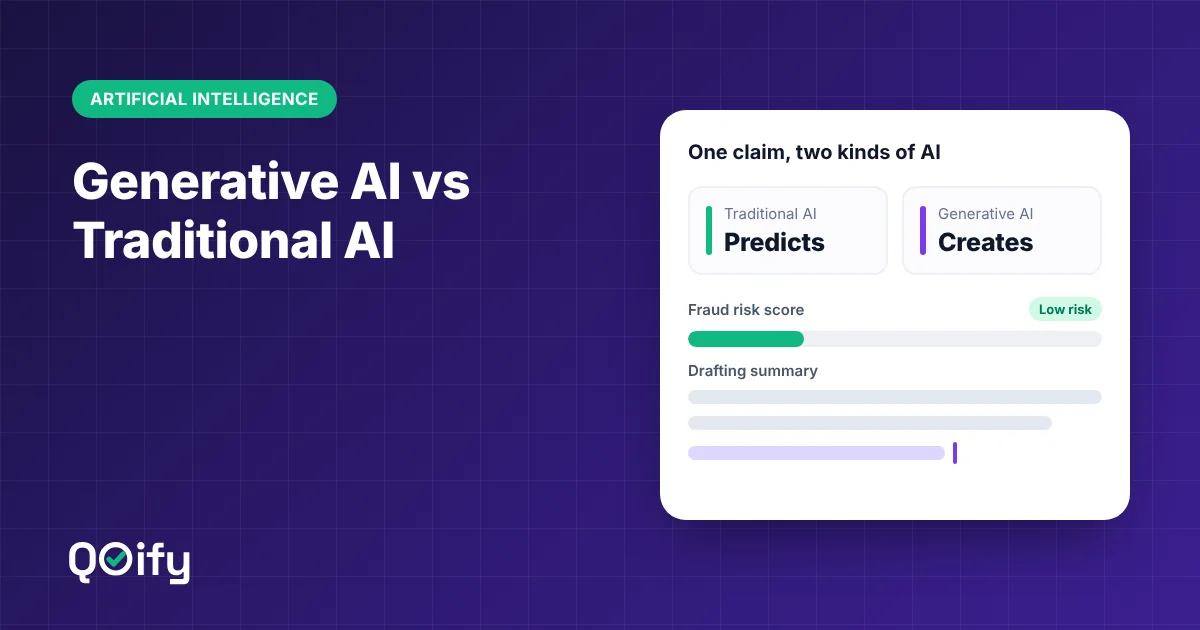
Traditional AI predicts; generative AI creates. Traditional AI, often called predictive or discriminative AI, learns from historical data to classify, score or forecast. It answers questions like "Is this transaction fraudulent?" or "How many units will we sell next month?". Generative AI learns patterns well enough to produce something new, such as a paragraph, an image, a summary or a block of code. It answers requests like "Draft a reply to this customer". The most valuable business systems usually combine the two.
The excitement around chatbots has made it easy to forget that most AI already running inside businesses is not generative at all. This guide explains how the two approaches differ, where each one fits, what they cost, how they fail, and how to decide which one a project needs.
What is traditional AI?
Traditional AI covers the techniques that dominated business use before large language models. It includes rule-based expert systems and, above all, machine learning models trained for one specific job.
You give the model labelled historical examples, such as past loan applications marked "repaid" or "defaulted". It learns which patterns lead to which outcome. Once trained, it takes a new input and returns a narrow, structured output:
- A category: spam or not spam, defect or no defect, high or low risk
- A number: a demand forecast, a price, a probability of churn
- A ranking: which products to recommend, which leads to call first
- A group: customer segments discovered by clustering
Because the output is constrained, you can measure it precisely. Either the model flagged the fraudulent transaction or it didn't.
What is generative AI?
Generative AI uses very large models, called foundation models, trained on enormous collections of text, images, audio or code. Large language models (LLMs) such as those behind ChatGPT, Claude and Gemini generate text one token at a time, choosing what is most likely to come next. Image models such as diffusion models gradually turn random noise into a picture that matches a description.
The defining feature is the open-ended output. You can't list every possible answer in advance. Ask for a product description and you get a new one each time. The same model can summarise a contract, translate an email and write a SQL query, all guided by plain-language instructions called prompts.
Generative AI vs traditional AI at a glance
| Traditional (predictive) AI | Generative AI | |
|---|---|---|
| Core question | "What is this?" / "What will happen?" | "Create something for me" |
| Typical output | A label, score, number or ranking | Text, images, audio, video or code |
| Training data | Your own labelled, mostly structured data | Huge general datasets, then optionally your documents |
| How you build it | Collect data → train a model → deploy | Pick a foundation model → prompt, ground in your data, optionally fine-tune |
| Scope | One task per model | Many tasks from one model |
| How you test it | Accuracy, precision, recall against known answers | Harder: rubric scoring, human review, test question sets |
| Typical failure | Wrong prediction, drift as data changes | Confident but false content (hallucination) |
| Explainability | Often easier to explain and audit | Hard to trace why a specific answer was produced |
| Running cost | Usually very cheap per prediction | Billed per token or per image, so cost grows with usage |
| Speed | Milliseconds | Often seconds for longer responses |
One business process, two kinds of AI
Abstract comparisons only go so far, so here is one insurance claim moving through a modern system:
- A customer uploads photos and a description of car damage.
- Traditional AI classifies the damage type from the photos and gives the claim a fraud risk score based on patterns in thousands of past claims.
- Traditional AI predicts the likely repair cost from vehicle model, damage category and region.
- Rules route low-risk, low-value claims for fast approval and send everything else to an adjuster.
- Generative AI drafts a plain-language summary of the claim for the adjuster, pulling details from the photos, the form and the policy document.
- Generative AI writes the customer update email, which a person reviews before it is sent.
Each technique does what it does best. The predictive models make the decisions that need to be measurable and auditable. The generative model handles reading and writing that used to take staff hours. We describe a similar platform in our insurance broker software case study.
When traditional AI is the better choice
Choose a predictive model when:
- The answer is one of a known set of outcomes, such as approve/decline, a category or a number.
- Accuracy must be measurable and consistent, as in credit decisions, fraud alerts, quality inspection or demand planning.
- You have good historical data with the outcomes recorded.
- Decisions must be explained to regulators, auditors or customers.
- The volume is high and the margin per decision is small, so you need cheap, fast predictions at scale.
When generative AI is the better choice
Choose a generative model when:
- The output is language or media, such as drafts, summaries, translations, descriptions or images.
- The input is messy and unstructured, such as emails, PDFs, call transcripts or long documents.
- The task changes often and retraining a model each time would be too slow.
- People need a conversational interface, such as internal assistants, customer support or search over company knowledge.
- A human will review the result, or a mistake is cheap to catch and correct.
Quick decision guide
| Task | Better fit | Why |
|---|---|---|
| Flag suspicious payments | Traditional | Measurable, high-volume, must be auditable |
| Forecast next quarter's demand | Traditional | Numeric prediction from historical data |
| Recommend products | Traditional | Ranking based on behaviour patterns |
| Summarise customer calls | Generative | Unstructured language in, language out |
| Answer staff questions from policy documents | Generative + retrieval | Conversational, grounded in your documents |
| Write first drafts of product descriptions | Generative | Creative text with human review |
| Extract fields from invoices | Either | Generative models handle varied layouts; trained extractors are cheaper at scale |
| Approve a loan | Traditional (+ generative for the letter) | Decision must be explainable; communication can be drafted |
Combining them: patterns that work
The most effective systems use each type of AI where it is strongest.
- Predict, then explain. A predictive model makes the decision. A generative model turns the result into a clear explanation for staff or customers.
- Generate, then check. A generative model drafts content. Rules or a classifier check it for missing fields, banned claims or policy violations before anyone sees it.
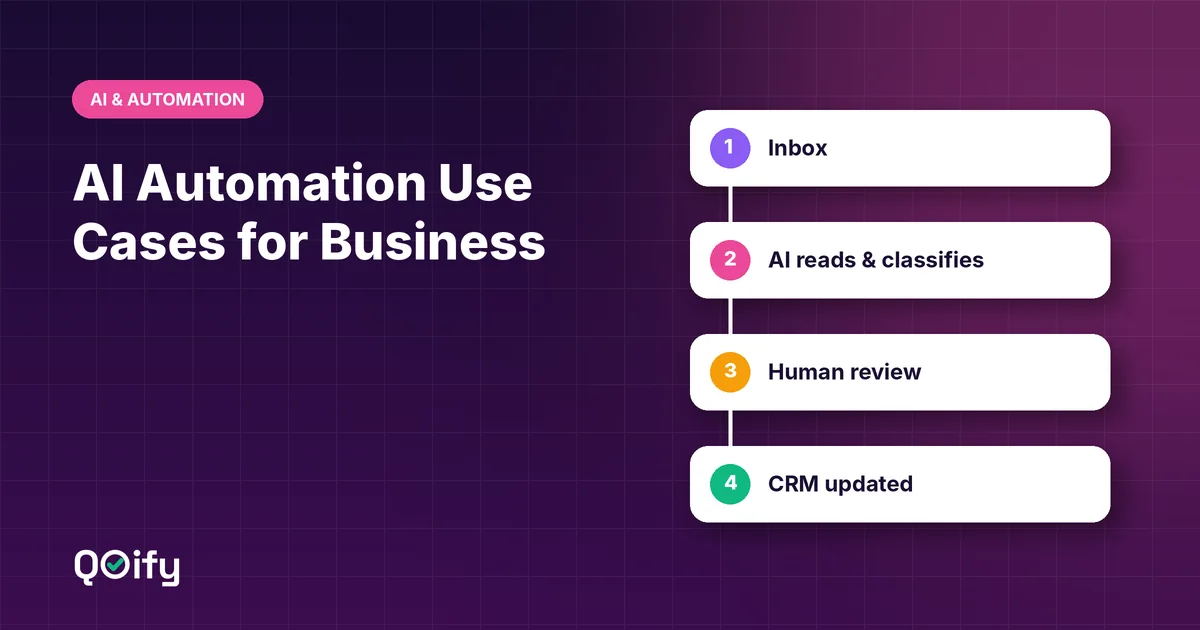
- Route, then respond. A classifier sorts incoming messages by topic and urgency. Generative AI drafts replies for the routine ones.
- Retrieve, then generate. Search finds the right passages in your own documents, and the generative model answers only from them. This approach, retrieval-augmented generation (RAG), is the main defence against AI hallucinations.
Risks and limitations of each
Traditional AI
- Data drift. Customer behaviour changes and model accuracy quietly drops unless you monitor and retrain.
- Bias in historical data. If past decisions were unfair, the model learns the same unfairness.
- Narrow scope. Each new task usually needs new data and a new model.
Generative AI
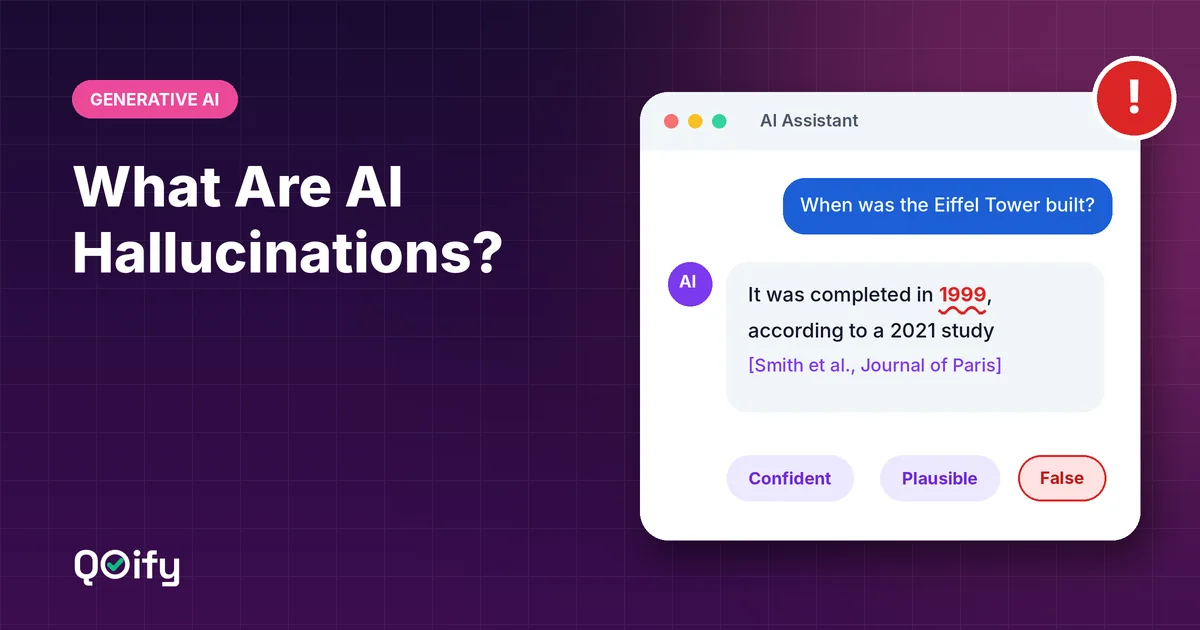
- Hallucinations. It can produce fluent, convincing content that is false.
- Data privacy. Prompts may contain confidential information, so check where data is processed and stored.
- Copyright and ownership questions around training data and generated output.
- Unpredictable costs as usage grows, and slower responses for long outputs.
- Harder evaluation. There is rarely one correct answer to compare against.
Both need human oversight, monitoring after launch and clear ownership. Governance doesn't stop being necessary because a model is impressive.
How to choose for your next AI project
- Start from the decision or task, not the technology. Write down what output you need and who will use it.
- Ask whether the output is a choice or a creation. Choices point to predictive AI; creations point to generative AI.
- Check your data. Predictive models need labelled history. Generative systems need well-organised documents if they are to answer from your own knowledge.
- Define how you will measure success before building: accuracy, time saved, error rate, customer satisfaction.
- Pilot on a narrow, real workflow with human review, then expand once you have evidence.
Conclusion
Generative AI and traditional AI are not rivals. They are different tools for different jobs. Traditional AI makes precise, measurable predictions from data, while generative AI reads, writes and creates. The question for a business isn't which one is better, but which part of a process needs a prediction and which part needs words, images or code. Teams that answer that clearly, and combine both with sensible human review, get the reliability of one and the flexibility of the other.