Before publishing: replace the [bracketed] project facts and the results with real, verified details from the project, and remove this note. Never publish results that were not measured.
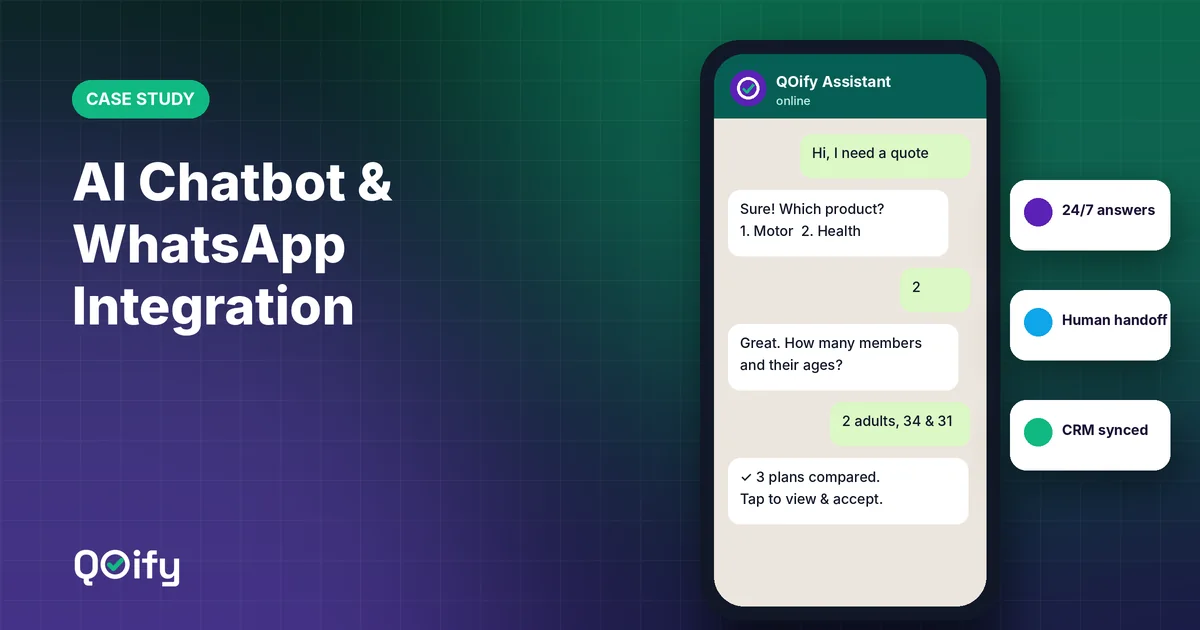
Customers expect answers in seconds, on the app they already use every day. For most businesses in India and the GCC that app is WhatsApp. We designed and built an AI chatbot integrated with the WhatsApp Business Platform that answers questions from the business's own documents, collects leads and quote requests, looks up live records in the CRM, and hands the conversation to a human whenever it should.
Project at a glance
| Detail | Value |
|---|---|
| Client | [Client name or industry, e.g. "A multi-branch insurance brokerage"] |
| Channels | WhatsApp Business Platform (Cloud API), website chat widget, staff inbox |
| Scope | AI assistant with retrieval-augmented generation (RAG), WhatsApp integration, CRM integration, human handoff, analytics |
| Languages | English and Hindi [edit to match the project] |
| Timeline | [X] weeks from discovery to launch |
| Tech stack | Node.js · TypeScript · React · MySQL · vector search · LLM API · WhatsApp Cloud API |
The challenge
The team was answering the same questions all day, on phone calls, e-mail and personal WhatsApp numbers:
- Repetitive questions consumed staff time. Policy coverage, documents required, payment status and renewal dates made up a large share of every day's messages.
- Slow replies outside office hours. Enquiries that arrived in the evening or at weekends waited until the next working day, and some customers went elsewhere.
- Leads lost in personal chats. Conversations on staff members' own phones never reached the CRM, so follow-ups were missed and managers had no visibility.
- No record or quality control. There was no shared history of what customers had been told, and no way to check answers for accuracy.
- Earlier chatbots were rigid. Menu-based bots frustrated customers who wrote in their own words, and simple AI demos gave confident but wrong answers.
Goals
| Goal | How we measure it |
|---|---|
| Answer common questions instantly, 24/7 | Share of conversations resolved without staff; first-response time |
| Answer only from approved information | Answers cite a source document; accuracy on a test set of real questions |
| Capture every lead in the CRM | Leads created automatically with source, product and contact details |
| Never trap a customer with a bot | One-tap handoff to a human, with the full conversation history |
| Stay compliant with WhatsApp policies | Opt-in, approved message templates and the 24-hour customer-service window respected |
The solution
1. WhatsApp Business Platform integration
We connected the business's verified WhatsApp number through the WhatsApp Cloud API. Incoming messages arrive at a secure webhook, are queued, and are answered in order, so nothing is lost during traffic spikes.
- Text, buttons, list messages and document replies (for example, sending a policy PDF)
- Approved message templates for messages outside the 24-hour service window, such as renewal and payment reminders
- Opt-in and opt-out handling built in
2. AI assistant grounded in the business's own knowledge
The assistant uses retrieval-augmented generation (RAG). Product brochures, FAQs, policy wordings, processes and price rules are split into passages and indexed for search. For each question, the most relevant passages are retrieved and the model must answer only from them.
- Every answer is linked to its source passage, which staff can review
- If the answer is not in the knowledge base, the assistant says so and offers a human
- Topics outside the business's scope are politely declined
- Content managers update the knowledge base from an admin screen, with no developer needed
3. Live data through secure tools
General knowledge comes from documents; personal information comes from systems. After verifying the customer (registered phone number plus a one-time code), the assistant can call approved tools:
- Look up policy status, renewal dates and outstanding invoices in the CRM
- Track a claim or service request
- Create a quote request or callback with all the details collected in the chat
The model never sees more data than the current, verified customer is allowed to see.
4. Lead capture and qualification
New enquiries are qualified in a natural conversation (product, requirement, budget, preferred contact time) and created as leads in the CRM with the source tagged as WhatsApp or website, then assigned to the right salesperson automatically.
5. Human handoff and shared inbox
Customers can type "agent" at any time, and the assistant hands over automatically for complaints, complex cases or low-confidence answers. Staff work from a shared web inbox that shows the full conversation, the customer's records and suggested replies, so no one has to ask the customer to repeat themselves.
6. Analytics and quality monitoring
A dashboard tracks conversation volume, resolution without staff, handoff reasons, response times, lead conversion and unanswered questions. Unanswered questions feed straight back into the knowledge base, so the assistant improves every week.
Architecture
| Layer | Choice | Why |
|---|---|---|
| Messaging | WhatsApp Cloud API webhooks, website chat widget | Official, reliable channel with delivery receipts |
| Orchestration | Node.js and TypeScript service with a message queue | Ordered processing, retries, no lost messages |
| AI | LLM API with RAG over a vector index | Answers grounded in approved content, with citations |
| Tools | Secure REST calls to the CRM and policy system | Live data for verified customers only |
| Data | MySQL for conversations, leads and audit logs | Full history and reporting |
| Admin | React web app: inbox, knowledge base, analytics | Staff manage everything without developers |
Safety, privacy and compliance
- Customer verification before any personal data is shared
- Role-based access in the staff inbox and full audit logs
- Personal data masked in logs and excluded from model training
- WhatsApp opt-in, template approval and service-window rules respected
- A test set of real questions is run before every change to prompts, models or content
Results
[Replace with measured results from the project, approved by the client. Useful measures:]
- Conversations resolved without staff: [X]%
- Median first-response time: from [X hours] to [Y seconds]
- Leads captured in the CRM from WhatsApp: [number] per month
- Answer accuracy on the test set: [X]%
- Customer satisfaction (post-chat rating): [X] / 5
Lessons learned
- Ground the AI before you launch it. Answering only from approved content, with citations and an honest "I don't know", is what makes a business chatbot trustworthy.
- Make the human handoff effortless. Customers accept a bot when they know a person is one tap away.
- Connect the chatbot to real systems. The biggest value comes from live lookups and leads that land in the CRM, not from general chat.
- Treat unanswered questions as a to-do list. Reviewing them weekly is the fastest way to improve accuracy.
- Follow WhatsApp's rules from day one. Opt-in, approved templates and the service window protect your number's quality rating.
Want an AI assistant on WhatsApp for your business?
We design, build and run AI assistants that answer from your own documents and connect to your systems. Talk to our team about your use case.