Short answer: choose an IT company the way you would hire a key employee. Check that they have built something similar, that they explain trade-offs in plain language, that they deliver in small, testable phases, and that you will own the code, data and accounts. Price matters, but a clear process and honest communication matter more for whether the project succeeds.
Hiring an IT company or software development partner is one of the biggest decisions a growing business makes. The right partner turns an idea into a product that customers use and your team relies on. The wrong one can cost months, budget and momentum. This guide gives you a practical checklist, the questions to ask, and the warning signs to watch for.
Start by defining what you need
Before you contact anyone, write one page that answers these questions. It will make every conversation faster and every quote easier to compare.
- The problem: what is slow, manual, expensive or missing today?
- The users: who will use the website, app or system, and what must they be able to do?
- The outcome: how will you know the project worked? For example, fewer hours on manual work, more enquiries, or faster quotes.
- Must-haves vs nice-to-haves: what is essential for a first release, and what can wait?
- Constraints: budget range, deadlines, existing systems to integrate with, and any compliance requirements.
You do not need a technical specification. A good partner will help you turn this page into one.
What kind of partner do you need?
| Type | Best for | Watch out for |
|---|---|---|
| Freelancer | Small, well-defined tasks; a simple website | Availability, single point of failure, limited range of skills |
| Small agency or IT company | Websites, web apps, custom software, AI and cloud with one accountable team | Make sure they have the specific skills your project needs |
| Large consultancy | Enterprise programmes with many teams and heavy governance | Higher cost, slower pace, junior staff on your project |
| In-house team | Long-term product development at scale | Hiring time and cost; hard to cover every skill early on |
Many growing businesses start with a small IT company for the first versions, then build an in-house team around the product once it is proven.
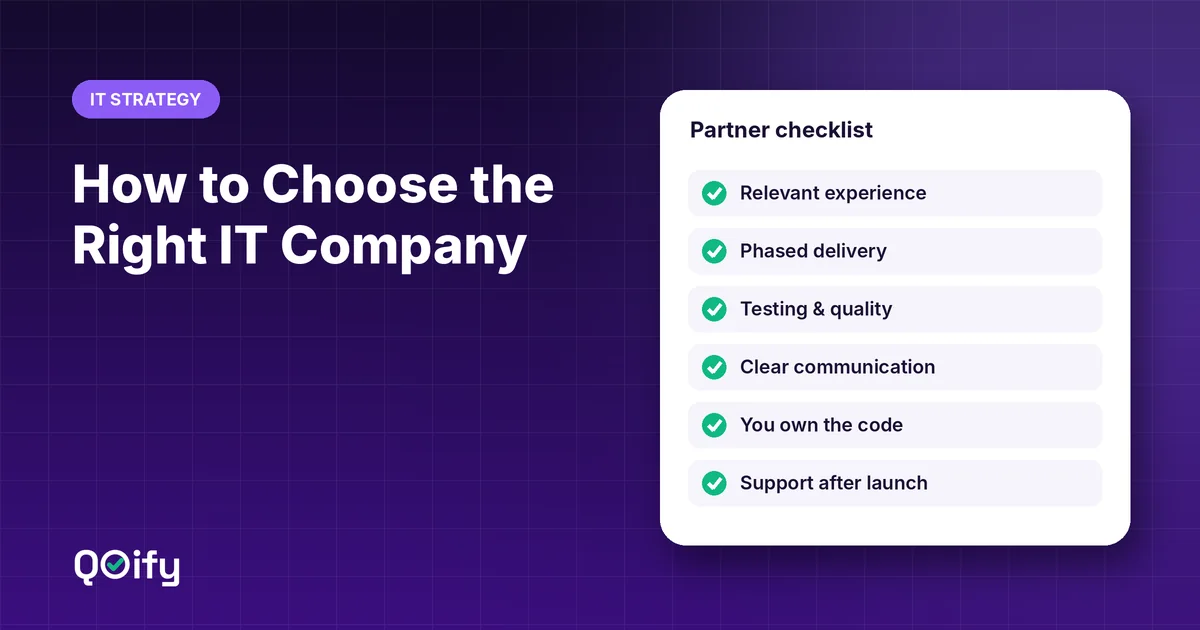
The checklist: 10 things to evaluate
1. Relevant experience
Ask for examples of similar projects: the same type of system (for example a portal, CRM or SaaS product), similar integrations, or the same industry. Case studies should explain the problem, the solution and what changed, not just show screenshots.
2. A clear, phased process
Good partners deliver in short cycles with working software you can try every few weeks. Ask them to describe how a typical project runs, from discovery to launch and support.
3. Discovery before a fixed price
A partner who quotes a fixed price for a complex system after a single call is guessing. Expect a short discovery phase, or a proposal that clearly states its assumptions.
4. Technical quality
You do not need to read code to assess quality. Ask how they handle code reviews, automated testing, security, backups and documentation. Ask what happens when something breaks after launch.
5. Design and user experience
Software that is hard to use does not get used. Ask who designs the screens, whether you will see wireframes or prototypes before development, and how they test with real users.
6. Communication
Notice how they communicate before you sign: response times, clarity, and whether they ask good questions. Agree on a single point of contact, a weekly update rhythm and a shared project board.
7. Ownership and access
Your contract should state that you own the custom code, designs and content once paid, and that domains, cloud accounts and app store accounts are in your company's name.
8. Security and privacy
Ask how they protect your data and your customers' data: access control, encryption, secrets management and compliance with the data protection laws that apply to you.
9. Support after launch
Every live system needs updates, monitoring and fixes. Ask what support plans they offer, response times, and the cost of small changes.
10. References
Speak to one or two past clients. Ask what went well, what went wrong, and how the partner handled problems.
Questions to ask in the first meeting
- What similar projects have you delivered, and what would you do differently now?
- What would you build first, and why?
- What are the biggest risks you see in this project?
- Who exactly will work on it, and what are their roles?
- How will we see progress, and how often?
- How do you estimate, and what happens if the scope changes?
- How do you test before each release?
- Who owns the code, designs, data and accounts?
- What does support look like after launch?
- Can we speak to a past client?
The quality of the answers, especially to question 3, tells you a lot. A partner who sees no risks has not thought about your project carefully.
Comparing quotes fairly
Quotes for the same project can vary widely, because each one makes different assumptions. To compare them:
- Check that each quote covers the same scope: design, development, testing, deployment, project management and support.
- Look at what is excluded, such as content, integrations, hosting or app store fees.
- Compare the number and timing of phases, not just the total.
- Ask how change requests are priced.
- Be cautious of a quote far below the others. It usually means missing scope, inexperience, or costs that appear later.
Fixed price or time and materials?
| Model | How it works | Best for |
|---|---|---|
| Fixed price per phase | Agreed scope and price for each phase | Well-understood requirements; predictable budgets |
| Time and materials | You pay for the time actually spent | Evolving products; research and experimentation |
| Retainer | A monthly allocation of time | Ongoing improvements, SEO and support |
A common, balanced approach is a fixed-price discovery and first release, followed by phased or retainer work as the product grows.
Red flags
- A fixed price for a complex system without understanding your workflow
- Promises of guaranteed rankings, traffic or "100% bug-free" software
- No questions about your users or business goals
- Unclear ownership of code, accounts or data
- No testing process, or testing left until the end
- Reluctance to share references or past work
- Pressure to sign immediately
Conclusion
The best IT partner is not the cheapest or the biggest. It is the one that understands your problem, explains choices honestly, delivers working software in small steps, and leaves you in full control of what you paid for. Prepare a one-page brief, use the checklist above, ask the ten questions, and choose the team you trust to tell you when something will not work.